Falls from heights remains the most common cause of workplace fatalities in the UK, with 39 deaths in 2013-14, which was 29% of total fatalities as reported by the HSE. It is a figure that remains stubbornly high, while there has been progress in reducing numbers, reported by employees, from other causes in the last five years. While the level of reported non-fatal injuries from falls was 2895 in 2013-14, well below the peak of 4684 of 2008-09, still there is much more training and safety education required to continue this downward trend.
Furthermore, fall injuries led to 567,000 working days (as reported by employees) lost in 2013-14, and there were 5952 recorded fall from height injuries from the same grouping.
The major industry for fatalities continues to be construction, including electricians and roofers, with other high risk sectors being agriculture, water supply, manufacturing, transport and storage, administration and support (the last mentioned including landscape gardeners, window cleaners and even social care workers).
In 2013-14 there were 73 convictions for breaches of the Work at Height Regulations 2005, slightly down on the peak figure of 81 in 2012-13, and the average fine was in excess of £8000.00.
Major causes of falls from height include falling through fragile surfaces, being hit by falling objects, operating in dangerous areas, coming into contact with machinery as a result of a fall, use of inadequate work equipment, or misuse of such equipment.
To emphasise the dangers of working at heights, Label Source supply a range of health and safety signs to warn of the inherent risks and dangers, as well as mandatory notices for the use of personal protective equipment, and maintenance labels and tags for use on work equipment.
Chemical spills can have serious, and sometimes devastating, consequences including human health issues, environmental pollution, structural building damage or contamination, and threats to corporate image and reputation.
Emergency procedures should be in place to provide a safe response by trained teams of staff, contractors or emergency services, using appropriate personal protective equipment to tackle any leak or seepage of dangerous substances or hazardous chemicals.
Our range of chemical hazard warning signs can be used to identify the type of risk posed by such chemicals including toxicity, flammability, explosion or corrosion. Thus, the risks can be assessed from chemical contact with skin or eyes, causing irritation or burns, or from internal injuries caused by inhalation or ingestion. The personal protective equipment, such as gloves, goggles, clothing and respirators should be used before tackling any spill, and first aid should be available to treat any contaminated personnel.
Our spill kit signs can be used to provide contact details for spill supervisors, and the emergency services. These cover different types of chemicals; non-aggressive fluids and oil or fuel (on land); oil or fuel on land and water; and aggressive fluids such as acids and alkalis. They cover the types of containment and neutralising agents for dispersal and disposal. One key task is to prevent chemical release to the atmosphere, water course or to soil. Spill areas can be cordoned off using our barrier tapes to prevent other workers or the general public from entry.
In addition, our dangerous substance storage containment signs can itemise chemicals, waste and any special waste, to allow emergency staff to assess the immediate risks.
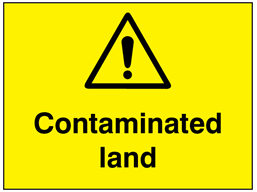
Contaminated land poses a number of safety issues ranging from impact on human and animal health, infection of soil, plants and fauna, and pollution of surface water or groundwater.
These sites of former industrial activity such as steelworks, refineries, mines or factories leaving residues of heavy metals, such as lead and cadmium; or mines and landfill sites producing methane gas; or special sites blighted with asbestos, radioactive substances or explosives.
These site pose dangers to workers, contractors and the general public from exposure to carcinogen and mutagenic elements through breathing or skin contact; from the ingestion of plants or vegetation ; damage to aquatic stock through soil contamination leaching into water courses, as well as other risks from corrosive, explosive or flammable waste; or asphyxiation from gases.
These zones need to be clearly marked to deter entry, and to warn of the hazards and dangers from entry into designated contaminated land sites.
The GHS (Globally Harmonised System) of Classification and Labelling of Chemicals becomes fully effective in the UK at the end of May 2015, and replaces the previous standards for marking of dangerous or hazardous substances and mixtures. So are you ready for the changes?
The GHS standards form part of the CLP Regulations, which make the regulations legally binding throughout the EU. The standards are aimed at protecting human health and safeguarding the environment by preventing chemical-related incidents or accidents where multiple classification systems previously existed and by streamlining health and safety training to reduce the level of injuries or illness.
While many of the GHS pictograms may be familiar to you, since they are closely based on the old EU classifications, there are some subtle changes plus the introduction of health hazards to humans (such as carcinogenic or mutagenic). Therefore, the new classifications replace the longstanding black on orange format classification structure, and these become legally binding on the 31st May.
Click here to purchase your new GHS labels and stay up-to-date with the latest regulations.
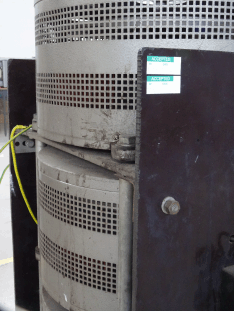
Maintenance labels are used to identify equipment, machinery, fittings, fixtures, tools and process plants have been maintained to a certain standard. These are used and displayed to inform workers and users of the risks and dangers, which are associated with the equipment that is to be handled.
Label Source provides a range of labels, tags and signs to help identify the dangers. Our range of Maintenance labels are used for a variety of procedures such as asset marking, tool numbering, identifying equipment, numbers, and dates maintained, who was maintained and serviced by, when the equipment needs repairing and serviced. The labels also include information informing people if the equipment is in or out of service, greased or non-greased. These labels can be used on mechanical plumbing, electrical, hydraulic and pneumatic equipment. The Maintenance labels are available in a self-adhesive material, and self-adhesive aluminium foil.
Furthermore, Label Source supply a range electrical maintenance tags. These tags are used for strict instructions, warning workers not to use, touch, operate, close, move the equipment. We also provide a range of yellow caution and warning stags informing workers of high voltage, wiring, and current of the equipment that is about to be handled. These tags are a tie on semi-rigid polypropylene plastic material.
These also come in a range of signs, which are to be displayed clearly, informing workers and users of any dangers and risks of the equipment. The signs are used to identify circuits, electrical appliances, serial numbers and equipment numbers. These rigid plastic signs are pre-drilled and can be used short term or for more permanent needs.