
Looking for bespoke / custom products?
Call us to discuss: 0800 3761 693

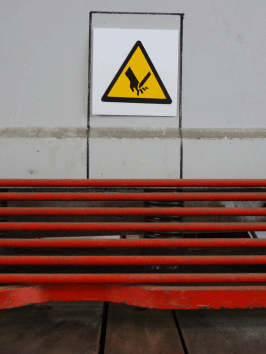
Any moving machinery or equipment in the workplace has the potential to cause injury to users. Even fully trained operatives following procedures, with fully maintained machines, with prescribed safety features and using appropriate protective clothing and equipment, have to be mindful that things can go wrong.

A whole range of differing injuries can be sustained including:

Entanglement between moving or rotating machinery, whether this be contact with hair, hands, jewellery or clothing. This can include equipment utilising rollers, belts or pulley drives.

Crush injuries from pinch points, or from being struck by moving parts.

Entrapment can result from being ensnared between different parts of the equipment, or between equipment and walls or other objects.

Cut and abrasion injuries can be caused by blades, shears or other sharp pointed component parts.

Electric shock injuries from direct exposure to machinery powered by mains voltages.

Burns and scalds from contact with hot surfaces, or ejected fluids or hot gases.

In the UK between the period, 2010/11 and 2014/15, 20% of all fatalities from accidents through contact with machinery in the manufacturing sector (Riddor). Annually around 70,000 self-reported injuries are recorded annually, and almost 29% of these result in absences of over 7 days duration (Labour Force Survey). The higher incident of above average workplace injuries can be found in firstly, skilled metal, electrical and electronic trades, and secondly, process, plant and machine operatives.

One key area to reinforce the message of vigilance when using such machines, equipment or tooling is to clearly mark the dangers during operation or maintenance and servicing is to use recognised safety signs and machine labels. Label Source has a comprehensive range of such products for use on machinery or their areas of operation. These include; electrical hazard safety signs; lockout products; general hazard warning signs; personal protective safety signs; chemical hazard safety warning signs; and safety labelling.


For more information on these products, together with customised labelling please contact Label Source by e-mail (sales@labelsource.co.uk) or by telephone 0800 3761693 (in UK) or +44 (1443) 842769 (outside UK).
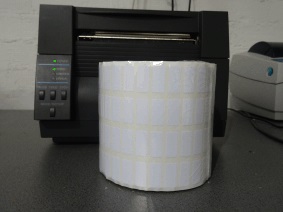
Thermal transfer printing can offer many benefits over direct thermal, laser or inkjet printing. It can provide durable, high definition labels, which can withstand exposure to ultraviolet (UV), and temperature extremes, and are chemical and abrasion resistant.

In addition, if printing is required other than black, there are coloured thermal transfer ribbons available, and with some materials there are colour options. Also, the thermal transfer technology allows the use of different substrate materials including paper, polypropylene, vinyl, destructible vinyl, polyester and tamper evident polyesters.

If you have an on-site demand for printing labels, for marking assets or inventory, healthcare or laboratory marking, quality control stickers, product nameplates and compliance labels, or shipping labelling, we have an extensive range of paper and synthetic labelstock on three core sizes, 76.2mm (3 inch), 25.4mm (1 inch) and 40mm. By combining our materials with the correct ribbon type, you can create long lasting labels for indoor or outdoor applications (weatherproof and waterproof for synthetics), including one and two dimensional barcodes, serial numbering, and labels conforming to CE, UL and CSA standards.

These labels are configured to be used on a variety of industrial, desktop and handheld printers from Zebra, Citizen, Toshiba TEC, Intermec and Datamatrix.

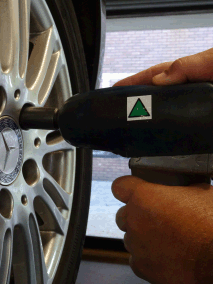
Many powered tools, equipment or machinery, used in the workplace, can cause injury from vibration, particularly if used for extended periods of time. These injuries can include hand and arm vibration syndrome (HAVS), vibration white finger (VWF) and whole body vibration excavators, dumpers, tractors etc.).

These are non-reversible injuries to blood vessels, muscles, nerves and joints in the hand and arm, and can result in pain and cold sensations, numbness, tingling and loss of sensation, loss of light touch, loss of grip strength or dexterity, blanching or whitening of fingers when exposed to cold, and bone cysts in fingers and wrists.

Sectors using such power tools are concentrated in construction, manufacturing, engineering, motor vehicle repair, mining and quarrying, agriculture, fisheries and in utilities. Hand held tools (such as grinders, hammer drills, needle guns or band saws), hand guided machinery (e.g. lawnmowers, chain saws, or compactors) or hand feeding to vibrating machinery (i.e. pedestal grinders) each provide vibration risks.

All such equipment should be risk assessed for the rate of vibration and safe period of use as outlined in the Control of Vibration at Work Regulations 2005 and the European Directive 2002/44/EC. Label Source provide a range of equipment labels, tags and signs for marking such powered tools, and for educating users on best practice to avoid vibration injuries. This can include the use of tensioners to support the weight of tools, provision of suitable personal protective equipment (PPE), instruction and training on correct tool use, as well as regular breaks from use and health screening.


For our full product range please click here.

As part of a programme of measures to tackle noise pollution, some 47 types of appliances need to be clearly marked with their decibel output during operation, as part of the Noise Emission Directive 2000/14/EC (The Noise Emission in the Environment by Equipment for Outdoor Regulations, 2001).

These include appliances and equipment powered by diesel or petrol, pneumatic or electrical, for use in construction, in civil engineering, forestry, parks and gardens, to control sound power levels.

Common products to be marked with their noise output levels include lawn mowers, trimmers, chain saws, shredders and chippers; dumpers, excavators, concrete mixers, aerial access platforms and mobile cranes; drills, jack hammers, sanders, arc welders, compactors and refuse collection vehicles.

Label Source has supplied many custom printed labels for product applications, not only including noise emission levels, but also company logos and contact details, CE marking, model numbers or serial numbers. These have been manufactured in a range of pressure sensitive labels in pvc or polyester, and in metals (aluminium or stainless steel), with surface laminates and coatings, all suitable for outdoor use. If you require a quotation please contact us by e-mail (sales@labelsource.co.uk) or by telephone 0800 3761693 (in UK) or +44 1443 842769 (outside UK).

A common perception is that all focus on electricity in the rail industry tends to be on track electrification of the railways. This is understandable considering that all media attention is concentrated on large civil engineering projects, such as HS2 or improvements on the Great Western, Midland Main Line or Trans-Pennine, to name a few. However, this is only one part of rail demand for electricity on rolling stock, ground equipment, mobile equipment or other infrastructure on over-ground and underground trains or urban transport (trams and light railways).

Existing track electrification in the UK comprises two separate systems. The majority of electrified track is powered by 25,000 V AC, while some of the older structures (known as “Third rail system”) operates on 660/750 V DC. Both these high voltage systems can hit the headlines, if contact with live lines result in fatalities or serious injuries from electrocution, or from electrical arcing flashing in the near vicinity of the track.

However, the majority of rail vehicles and other rail application equipment operate on low voltage electricity. This can include lighting, wall sockets, air conditioning, battery charging and fans on carriages. All such electronic equipment designed for control, regulation, protection or power supply on rail vehicles has to comply with EN50155 2007. A further standard EN50121 regulates the electromagnetic compatibility (EMC) of equipment on rolling stock, signalling and telecommunications to enable safe systems of work and operation.

Other low voltage (LV) uses on the rail network are numerous. These include on train stations; information systems; public address systems; ticket barrier entry systems; heating, ventilation and fire alarms; concourse power and lighting. Platform equipment can include; metering systems; track side degreasers; de-icer control equipment; signalling and surge protection; cable shielding systems; electrically operated; catering equipment; and power traction and control systems. At substations there are numerous transformers, electric switchgear, circuit breakers, isolators, converters and allied power supplies.

All these low voltage applications still carry dangers of electrocution on contact with exposed electrical equipment or appliances, which can lead to cardiac arrest, muscle, nerve and tissue damage, thermal burns (off hot surfaces) or electrical burns.


Here, at Label Source, we have supplied a selection of identification products, such as health and safety signs, safe operation signs, electrical hazard warning labels, PAT test labels, plant maintenance labels and signs, microwave oven safety labels, cable and conductor markers. Examples are 110V labels for battery systems, 230 V stickers for power lighting and wall sockets, 400 V markers for air conditioning, air compressors and battery charges, and 650 V labels for two phase signalling power supplies.
