Looking for bespoke / custom products?
Call us to discuss: 0800 3761 693

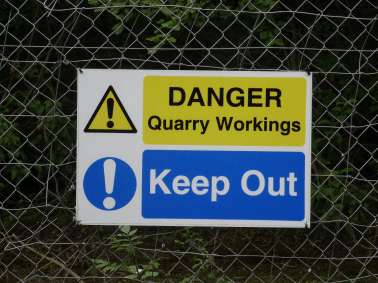
Quarries can be dangerous places, at the best of times, and the potential hazards are manifold, even if the site is operational or dis-used. Many of these hazards may exist where rock or aggregate is being extracted by a combination of drilling, boring, blasting or crushing. Some of these hazards for working quarries are outlined below, with links to Label Source products to create awareness of these occupational health and safety dangers.

Breathing hazards can be caused by airborne dust particles, which are a natural consequence of the quarrying process, and these can be combined with inhalation of engine exhaust fumes or fumes from welding  can lead to respiratory problems, particularly silicosis (from exposure to silicon particles).

Eye hazards can be caused by contact with dust, stone fragments or from on-site arc welding can damage the retina.

Ionising radiation hazards can occur from naturally released radon gas, and from the use of radioactive substances within instrumentation.

Non-ionising radiation hazards stem from over exposure to the UV in direct sunlight, and from the infrared and ultraviolet effects from arc welding which can affect those welding and others in the proximity.

Hearing hazards from excessive noise levels from plant, equipment, vehicles and blasting can lead to deterioration in hearing to deafness, or the onset of the hearing sensation tinnitus.

Vibration hazards can include HAVS (Hand arm vibration syndrome) from the continual handling of equipment such as road breaking hammer drills, angle grinders, chain saws and disc cutters, resulting in complaints such as finger blanching, pain, and permanent loss of sensation. In addition, whole body vibration symptoms can be caused from operating quarry vehicles and fixed plant, which can cause back and neck pain.

Skin complaints can lead to skin cancer for exposure to excessive ultraviolet light, and dermatitis from contact with oil lubricants, grease, solvents and bitumen.

Manual handling injuries can be caused by operating heavy quarry equipment, the manual shovelling of earth, clay and shales, and the lifting and carrying of heavy stones.

Weather hazards include operating in high or low temperatures, in excessive humidity, heavy rain or snow, and skin exposure to sunlight as covered above.

Other hazards can cover: Injuries from falling rocks; accidents to drivers and pedestrians from vehicle collisions, or overturning vehicles ; confined space incidents; injuries from slips, trips and falls; crush, entrapment, pinch and finger trap, punch or blade injuries can be caused during machine maintenance; explosion and fire hazards from explosives, primers and detonators, from flammable materials such as paint, thinners and cleaning fluids); and COSHH issues from chemical hazards, such as battery and hydrochloric acids etc.).

At the end of quarrying operations, while many of the above cease to be relevant, that does not mean that all safety threats end. Rather the type of risks change. Many result from unauthorised access to the quarry by children, bikers and quadbikers which can lead to safety issues from falling objects, entrapment from digging, falls from climbing, and injuries from slips and falls down steep surfaces or from cliff edges, and overturned vehicles. Flooded quarries can pose dangers from swimming or diving in deep, cold water, with strong under-currents and with the possibility of collisions with underwater obstacles.


Besides the above health and safety products, Label Source has supplied many asset tags for equipment, conveyor belts and rollers, electrical warning labels, maintenance labels and tags, traffic signs, and contaminated land signs. For further information on any of these products, please contact Label Source by e-mail (sales@labelsource.co.uk) or by telephone (0800 3761693 in UK, or + 44 1443 842769 if outside the UK).
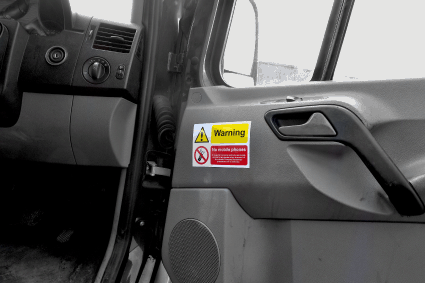
The new mobile phone law 2017 has increased the punishment for using a mobile phone when driving. The fixed penalty fine has increased from £100 to £200, and penalty points on your licence have increased from 3 to 6. Maximum fines for car or motorbike drivers, if the case proceeds to court can have an increased fine imposed of up to £1000, and for bus or HGV drivers this has been raised to £2500. Any motorists with less than two years driving experience will have their licence revoked meaning an application for a new provisional, and the retaking of the driving test.


The news media continues to report on serious traffic accidents, many including fatalities, resulting from loss of control while driving at the same time when using a mobile phone or device.

While the offence has existed since 2003, the increased penalties are a method of trying to change behaviour. A report from the RAC in 2016 has revealed an increasing use to take images or video while driving, and for written emails, texts or social media updates behind the wheel, as well as those that use the hand held phones for making or receiving calls.


In response to this Label Source has introduced a range of labels to warn against using hand held mobile devices while driving. See the following links to products;

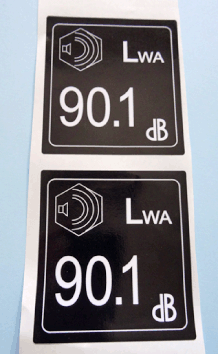
Label Source has worked with many customers to provide labelling on their equipment to comply with the Noise Emissions Regulations 2001, and Noise Emissions Regulations (Amendment) 2005. This includes outdoor equipment for construction, road repair, agriculture, forestry, landscaping, woodworking,

If you need to mark outdoor equipment with noise emission labels, Label Source has worked with many customers to comply with the Noise Emissions Regulations 2001 and the Noise Emissions Regulations (Amendment) 2005.

Our labels are waterproof, abrasion, chemical and weather resistant (including UV resistant) and clearly state the decibel sound power level during equipment operation. Also, we can manufacture separate labels or combination labels with the CE conformity marking logo for compliance with Directive 2000/14/EC.

Whether these designated outdoor equipment products are manufactured in the EU, or imported from outside the EU, these need to comply with the standards and should be marked accordingly.

The products covered by the Regulations include those that have noise emission limits, and others that require noise marking only. Equipment covered includes that for construction, such as hoists, compactors, concrete breakers, dumpers, excavators, generators etc., forestry, landscaping and agriculture (lawn mowers, grass and hedge trimmers, chain saws, shredders, leaf blowers and collectors), woodworking equipment, road construction and repair, waste recycling and vehicles (such as refuse collection vehicles, snow removing machines and lift trucks).


For further details on these products please contact Label Source, by telephone (0800 3761693 in UK, or +44 (0) 1443 842769 from outside the UK), or by e-mail (sales@labelsource.co.uk).

The Eurasian Economic Community, comprising Russia, Kazakhstan and Belarus, have technical compliance regulations on a wide range of consumer and industrial goods, and this is embodied in the EAC mark. This is comparable with the CE mark within the European Union, and covers harmonised technical and safety standards.

Products covered by EAC for safe operation include low voltage equipment, machinery and equipment, lifts, machines in potentially explosive atmospheres, machines operating on gaseous fuel, personal protective equipment, pressure vessels, agricultural and forestry tractors and trailers, and railway rolling stock and infrastructure.

The EAC mark is depicted and the character height should be a minimum of 5mm, and be in a single colour, and consists of the three letters of uniform height created within a square.


Beside the standard ranges available, additionally Label Source can supply custom labels incorporating the EAC symbol within the design.

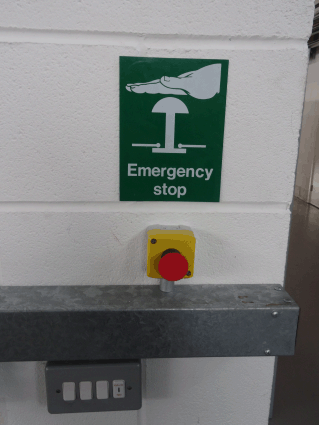
In order to comply with current law, it is essential that most machinery is equipped with an emergency stop facility, so that power can be shut off, in the event of a malfunction, accident or exceeding operating parameters.

The UK regulations stem from European Directive 2006/42/EC, which can be found in the Supply of Machinery (Safety) Regulations 2008 and the Supply of Machinery (Safety) Amended Regulations 2011. In addition the Gas Safety (Installation and Use) Regulations 1998 provide guidance and approved codes of practice and cover the safe cut off of gas appliances.

Here at Label Source, we have a range of sign products suitable for the clear identification of such cut off points for power, electricity and gas. In addition, our hazard warning signs can identify potential risks with specific machines, and these include; pinch points; sharp blades; finger traps; automatic start up; rotating blades; moving belts (including belt rollers and belt drives); crush; foot traps; entanglement; and entrapment.

While the more obvious reason to shut off equipment would be due to operator injury, a range of other criteria could be the cause. These can include; high temperature; potential of fire or explosion; excessive noise or vibration; or emissions such as radiation or hazardous substances.

The standards apply to machinery, interchangeable equipment, safety components, lifting accessories, chains ropes and webbing, removable mechanical transmission devices and partly completed machinery.

Some key machinery categories are industrial machines, woodworking machinery, food processing equipment, agricultural equipment, locomotives, and trains and hoists. However, some items such as conveyor belts, treadmills in gyms, carousels for luggage retrieval at airports and bowling alley equipment are covered by the regulations.


So, if you need to identify safety cut offs to electricity or gas supply to equipment, or need to create awareness of risks and hazards when operating machinery, we have a wide range of standard products as well as providing bespoke products to your own specification.